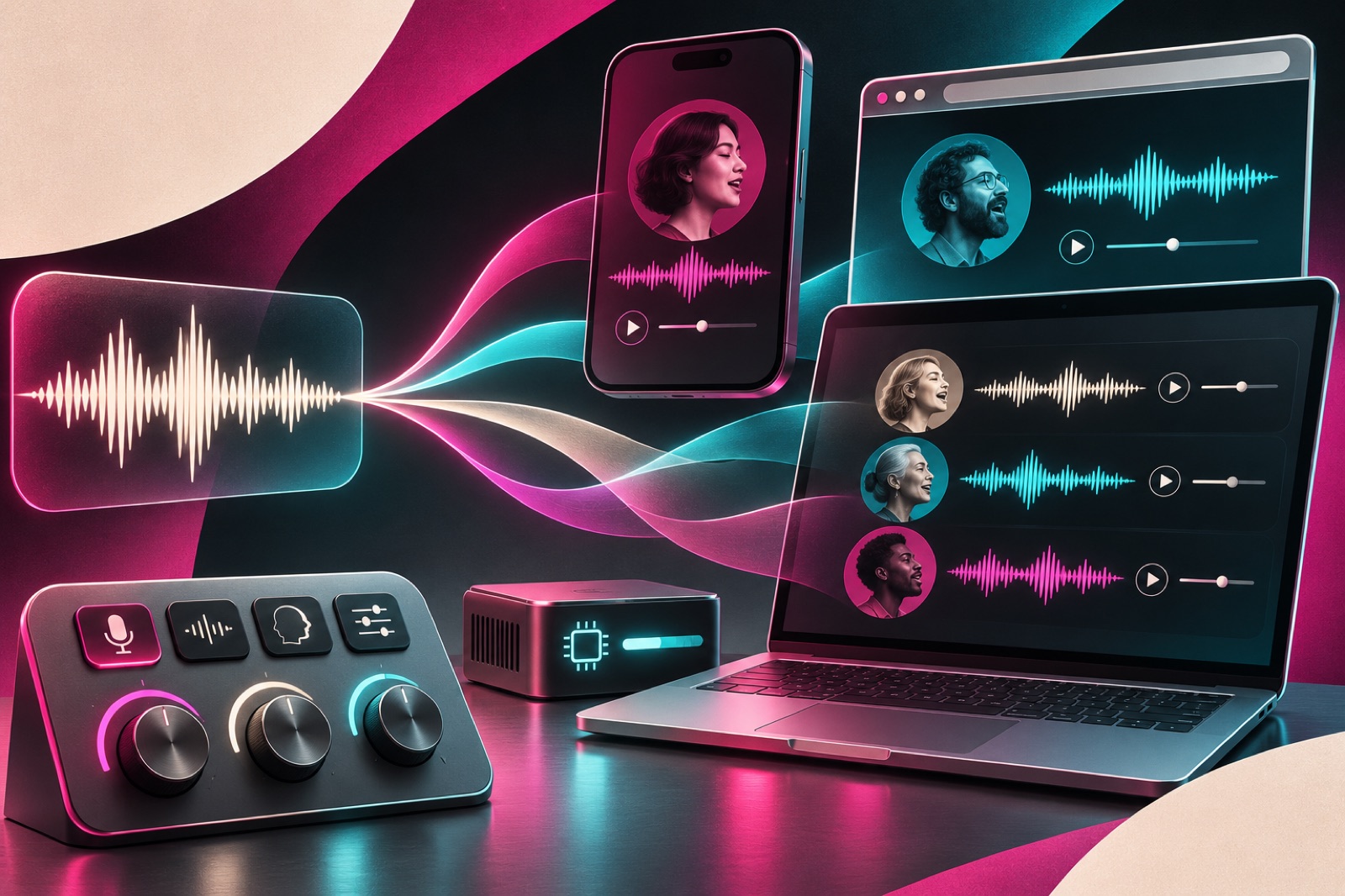
A voice agent is not only a speech-quality problem. Latency changes whether a turn feels natural, privacy changes where the product can be used, and the ability to work offline changes what happens when the network disappears. Moving inference onto the device turns those constraints into product decisions.
Zyphra's ZONOS3-Mini release is built around that possibility. The authors describe an Apache 2.0 model with 100 million active parameters and 800 million total parameters, a 15 Hz dual codec called ZAC-1, and a hybrid Gated DeltaNet and Attention Latent MoE backbone.
The small path is the feature
The release targets zero-shot voice cloning and steerable text-to-speech, with support for 43 languages and real-time use across browsers, phones, laptops, and servers. It also ships with weights, a Transformers integration, a WebGPU playground, and evaluation tooling, which gives builders more than a hosted demo to start from.
The claims are promising but operationally specific. Real-time on a server does not guarantee real-time on a phone, and a cloned voice is not automatically safe to use. A production voice agent needs consent records, speaker boundaries, a way to disclose synthetic speech, and a fallback when the local device cannot meet the latency target.
Local voice is a product decision about control: who holds the audio, what still works offline, and which device is trusted to speak.
Measure the whole conversation
A useful first experiment is a constrained device matrix. Test first-token latency, interruption handling, memory use, voice similarity, and failure behavior on a phone, laptop, and server. If the local path is not always faster, it can still be valuable when it keeps sensitive audio local and gives the user a predictable offline mode.
Zyphra presents ZONOS3-Mini as an Apache 2.0 model with 100 million active and 800 million total parameters, a 15 Hz ZAC-1 codec, a hybrid Gated DeltaNet and Attention Latent MoE backbone, 43-language support, and real-time targets across browsers, phones, laptops, and servers. These capabilities are described by the authors and should be tested on the target device.
Hugging Face · ZONOS3-Mini ↗