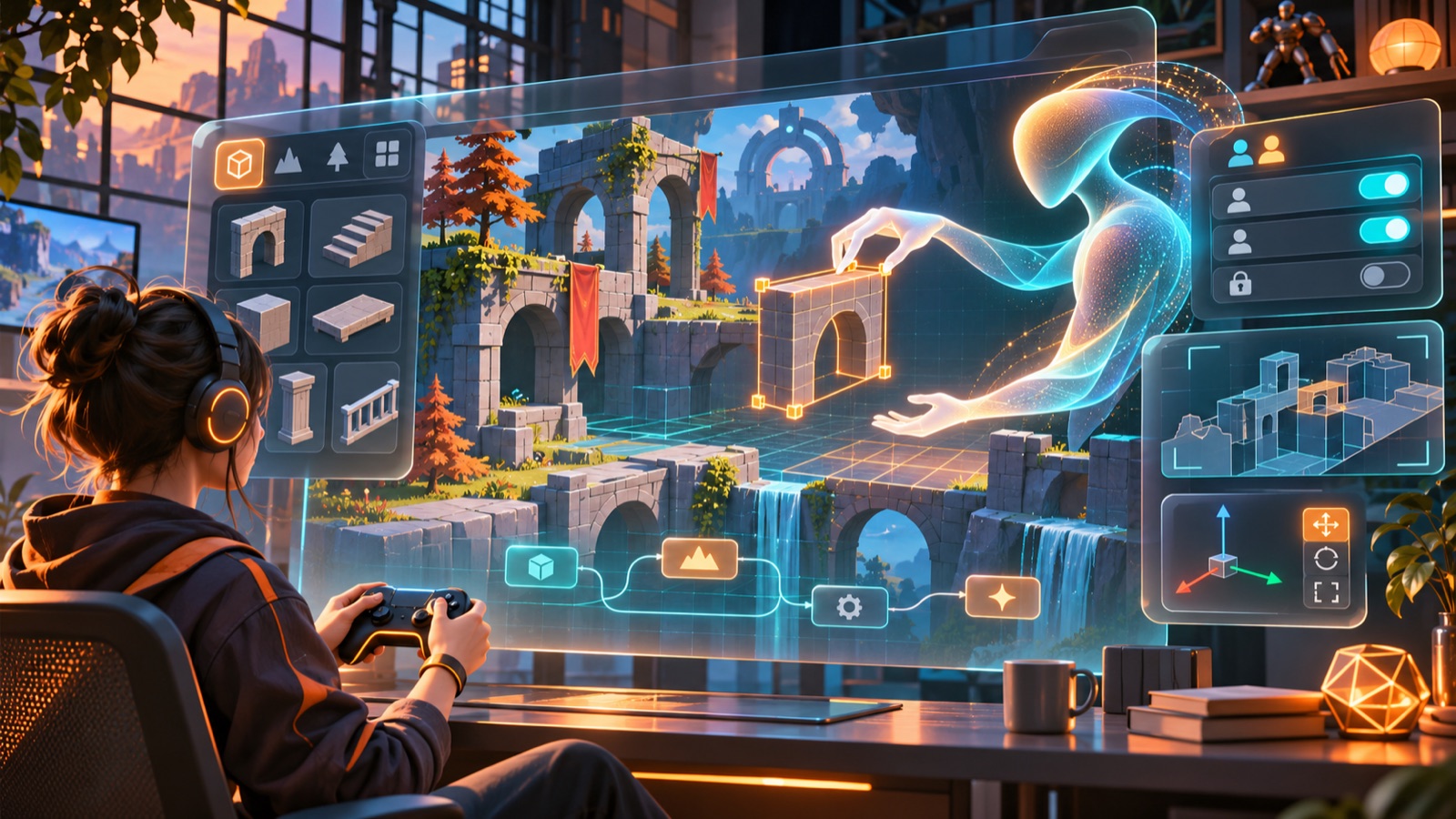
A game editor is no longer only a canvas for a human. Once an agent can reach the scene, assets, and tools, it needs project context while the creator needs to see and change the boundaries of its work.
In the Unreal Engine 5.9 preview notes, Epic describes Unreal Canvas as a shared workspace where people and agents create and refine content. The preview includes prompt-driven generation for text, images, video, and mesh assets.
The editor as a workspace
The notes also list an improved Unreal MCP, semantic search, a knowledge base, and expanded toolsets. Toolset Registry gathers the available tools, while external agents can receive access settings that range from Ask and Read through Edit, Auto, and Full.
This is more than convenience. An agent that sees the same editor state as a person can work from more specific context. Every new capability is also a new place to explain what can change and how the change can be reversed.
The editor becomes a shared workspace only when tool access is visible and reversible.
Start with one task
Builders should pick one repeatable task, restrict the toolset, record edits, and require review for destructive actions. Because these are preview and experimental features, test the concrete project, editor version, and recovery path after a mistake.
Epic's official preview notes describe Unreal Canvas as a shared workspace for people and agents, plus Unreal MCP improvements, semantic search, a knowledge base, a Toolset Registry, external-agent handoff, and Ask, Read, Edit, Auto, and Full access settings. These are preview and experimental features, not a production-readiness guarantee.
Epic Developer Community · Unreal Engine 5.9 Preview Release Notes ↗