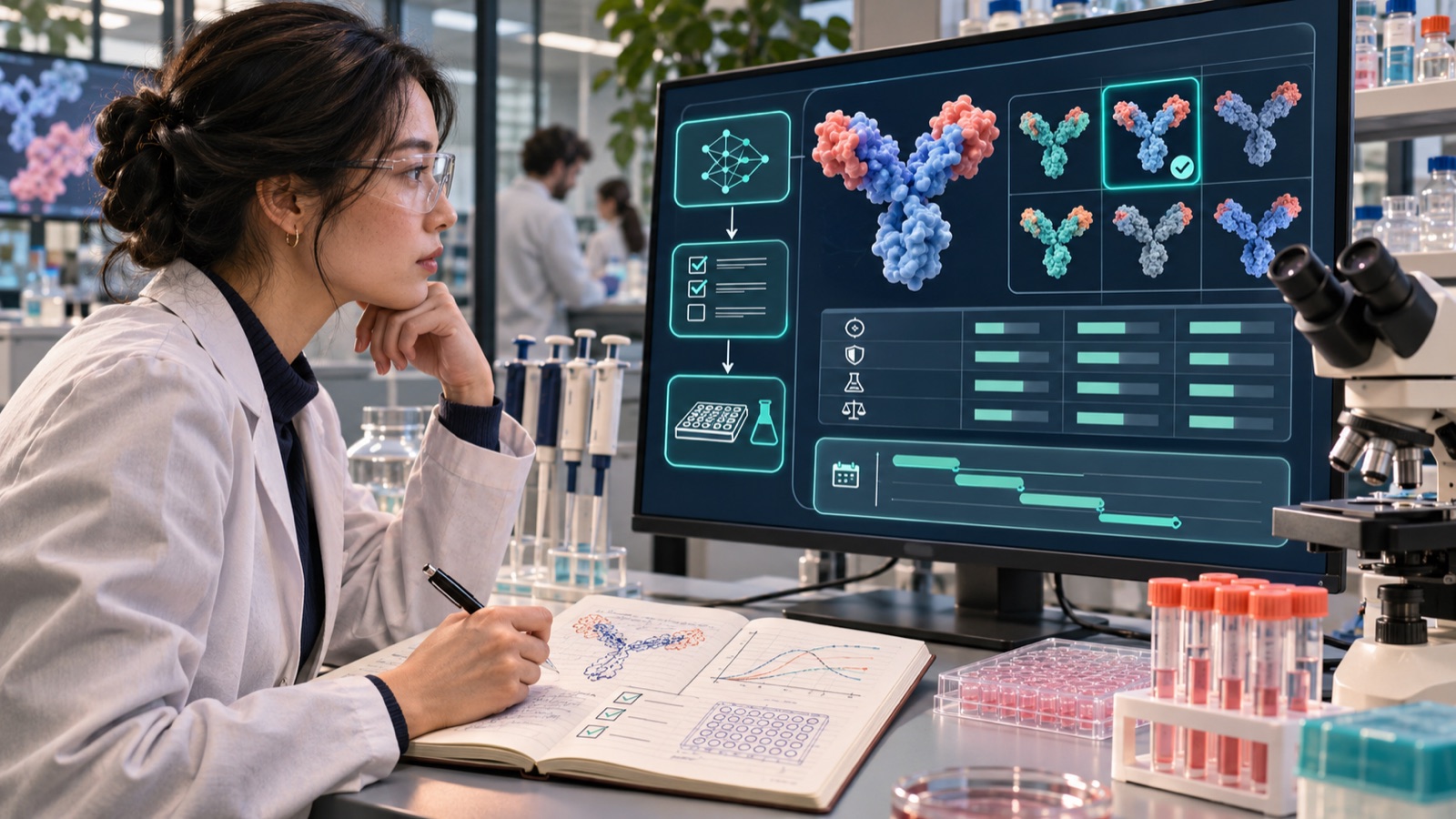
Drug discovery is not only a problem of finding a promising molecule. It is also a coordination problem: contracts, external labs, experiment queues, data reviews, and decisions about which result deserves the next round of work.
Anthropic's October 27 life-sciences report uses Mithril Medicine to show what happens when a very small team treats an AI system as an operations layer. Anthropic says founder Cody Tranbarger used Claude to organize work across 11 external labs and helped move a possible treatment for a rare muscular dystrophy from an idea to promising results in mice in less than 18 months.
The hard part is still validation
The same report describes partnerships with BigHat Biosciences, Bristol Myers Squibb, Divergence Labs, Enveda, Generate Biomedicines, and The Column Group. The work ranges from antibody design to clinical-trial planning, but Anthropic explicitly says most of it is preclinical and not yet tested in humans. That caveat matters more than the speed claim.
A one-person pipeline does not remove scientific review. It changes how much coordination one researcher can carry before the next experiment.
For builders, Mithril is an example of leverage rather than an autonomous lab. The useful system connects a person to specialized tools, consultants, and partner labs, keeps the operational state legible, and makes every promising result earn another round of evidence. Future clinical dates in the report are targets, not outcomes.
Anthropic reports work with six life-sciences organizations and says Mithril founder Cody Tranbarger used Claude to organize contracts, logistics, and experiments with 11 external labs; the reported mouse results are preclinical, and timelines after 2026 are targets rather than commitments.
Anthropic · Early progress on accelerating drug development with Claude ↗